IN CONVERSATION WITH… PAUL SINCLAIR & EMEAFA HARDCASTLE – 2
Share:
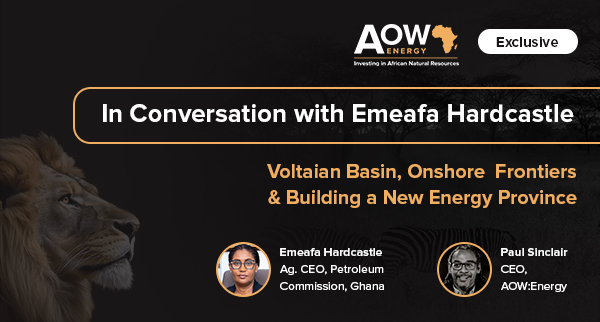
IN CONVERSATION WITH… PAUL SINCLAIR & EMEAFA HARDCASTLE
INTERVIEW 2 : VOLTAIAN BASIN, ONSHORE FRONTIERS & BUILDING A NEW ENERGY PROVINCE
Paul Sinclair:
Following our last meeting about the Sub Region and the outlook of exploration and production, I wanted to move onshore. The Voltaian Basin is enormous, over 100,000 square kilometres. It’s one of Africa’s least explored basins but the opportunity is proving to be unprecedented. When you look at it today, what stands out to you?
Emeafa Hardcastle:
What stands out to me is not only the scale of the opportunity of the Voltaian Basin, but also our improved ability to properly evaluate it.
In the past, one key challenge of the Voltaian Basin has been the presence of a working petroleum system. Critical elements such as Reservoir, Source Rock, Migration Pathways, and an effective Cap Rock have historically posed significant risks.
Today, however, we have acquired extensive Geological and Geochemical datasets alongside over 5,000 km of 2D seismic lines, which have enabled us to substantially de-risk these elements to acceptable levels. For example, through inhouse analysis, we have noticed that soil gas data available from the geochemical surveys conducted contain significant concentrations of methane, ethane, propane, and butane. These are light hydrocarbon gases that may well be considered as confirming the existence of active oil and gas sources within the Basin.
Moreover, the planned exploration wells by GNPC Explorco also represent a significant step toward unlocking the full potential of the basin.
We are very excited about the prospectivity of the Voltaian Basin and its potential to change the lives of our people.
Paul Sinclair:
GNPC Explorco is clearly preparing for drilling activity and seeking partners. How is that process working in practice?
Emeafa Hardcastle:
It is very structured as GNPC Explorco is actively preparing for its drilling campaign. Also, Explorco is engaging with potential partners through farm-down opportunities.
We are looking for companies that brings technical strength and financial capability, but also a willingness to work within a long-term partnership framework.
Onshore exploration in Ghana is relatively nascent and requires a different approach to development, it requires drilling expertise, logistics, infrastructure planning, and strong local integration.
We are encouraging companies with the appetite for onshore exploration and production to engage with us now, and at AOW Energy, where we can host formal data rooms, technical meetings, and investor sessions specifically for the Voltaian Basin.
Paul Sinclair:
So when companies come to AOW:Energy, they can sit down with PC, Explorco and the broader stakeholder groups to review the basin in detail?
Emeafa Hardcastle:
That is our goal, we really want to maximise AOW:Energy, we don’t have to wait until then to open discussions, but we do want to make sure the sector knows that when it comes to AOW:Energy, we will be ready technically to dive into the geology and above ground to set the scene and to move conversation to action.
At AOW:Energy, we will have dedicated Voltaian Basin sessions where companies can engage directly with our teams, review datasets, and discuss commercial structures.
We will also have government-led meeting programmes, which allow investors to sit directly with decision-makers and move interest to commitments. We want to make this a platform for active deal-making.
And importantly, they are not only meeting Ghana and Ghanaian opportunity. We are proud to be hosting the regional regulators, NOCs, and government leadership in Accra. We will ensure that the event is not only good for Ghana, but we carry the opportunity to promote our region as a whole. So, by attending AOW:Energy, investors and operators are also engaging with more than 30 African governments, all of whom are bringing upstream opportunities to the event, just as we the Ghanaian government will. That is what makes it unique.
Paul Sinclair:
Agree, I totally agree and it’s a crucial point, you’re essentially saying this is not just a Ghana event, it’s an African upstream convergence.
Emeafa Hardcastle:
That’s it, and for me that is why AOW:Energy is so powerful, it’s a regional event of purpose, and we are determined to provide equitable upsides for all across the region and sector.
Paul Sinclair:
Let’s talk about infrastructure. Onshore basins are not just as good as the subsurface and geology, it’s also about the infrastructure, the roads, logistics, services, and local content development. How is Ghana approaching that?
Emeafa Hardcastle:
We are approaching it as part of a broader development strategy and one that we passionately believe will give us the advantage we need to attract investment and partners.
The Voltaian Basin is a regional development opportunity that has the potential to stimulate economic growth in across Ghana, create jobs, and build new industrial capacity. I really think the end-to-end supply chain can develop upside, and then the natural resource development also that will contribute to economic advancement.
So yes, infrastructure is critical, but we see it as an opportunity rather than a constraint.
IN CONVERSATION WITH… PAUL SINCLAIR & EMEAFA HARDCASTLE
INTERVIEW 3 : REGULATORY REFORM, INVESTMENT CLIMATE & AFRICA’S COMPETITIVE UPSTREAM FUTURE
Paul Sinclair:
Emeafa, let us talk about something that underpins everything we have discussed previously about geology and the rocks, and that is the regulatory environment here in Ghana. There’s been a lot of discussion in the industry about competitiveness, fiscal terms, and reform that could see Ghana take the lead as an investment choice, the rocks speak for themselves, but I sense a growing anticipation around how as a country Ghana is looking to compete via regulation, policy and fiscal terms. Where is Ghana right now in that conversation?
Emeafa Hardcastle:
We are in a highly active and constructive phase of review, and we know that competitive terms above ground will transform our sector. We have been blessed with amazing geology, and let’s be clear, basins are not confined to the boarders we see on a map. For investors, Ghana is an exciting place to be. I am glad this has been proven with steady increase in FDI over the years. The country has tremendous investment opportunities given its natural and human resource abundance and relatively well developed infratsructure.
That said, we know competitive terms accelerate investment, just look at what has been achieved in Cote d`Ivoire. So, we want to make sure we give Ghana the best possible chance of success and that lies in developing enabling and competitive frameworks for the above ground, and I believe we can achieve this sooner rather than later.
We recognise that the global upstream environment is highly competitive. Capital is mobile and seeks the best returns, and investors have many options across Africa and beyond, so we need to make sure we compete at the best level possible without compromising the value we retain in Ghana for our people. Beyond improving fiscal attractiveness, the key to investment attraction is regulatory predictability, certainty and respect of sanctity of
Let me reiterate that message I began with this interview, Ghana is an exciting destination for petroleum and other investments. It is possible to invest securely and profitably for the long term.
AOW:Energy will surely provide us a real opportunity for E&P companies to show to the world that their investments in Ghana are good for themselves, good for the country, and good for the people.
So, our focus is ensuring that Ghana remains attractive, while also ensuring that we protect national value and deliver benefits to our people. That balance is especially important to us.
Paul Sinclair:
And how do you achieve that balance in practice?
Emeafa Hardcastle:
Through pragmatism and engagement, through understanding market drivers and analysis of how we achieve the best results for Ghana while attracting as much investment as possible. We are working closely with industry to ensure that our regulatory and fiscal frameworks support investment while maintaining fairness. It is about balance.
Ghana has demonstrated over the years that, it is possible to invest securely and profitably for the long term in this country. Investors just have to follow common sense principles in investment -: Align Investments with the Country’s Development Priorities; Practice Transparency; Add Value to the Country and its People; Pay What is Due to the State and Do What is Right; and Engage with Local Communities.
With AOW:Energies: There is a real opportunity for Investors to show to the world that their investments in Ghana are good for their Shareholders, and good for the country.
We want more exploration, more production, and more partnerships. And we believe that is achievable through a well-calibrated framework.
Paul Sinclair:
There is a lot of speculation in the market that Ghana is moving toward more competitive fiscal terms. Is that fair?
Emeafa Hardcastle:
What I would say is that we are always reviewing how to remain competitive, we will always be making recommendations, and our government is not shy in making the right decisions to advance prosperity for our citizens. Our focus is on rewarding investors that take risks in deeper and ultra deeper water and the frontier basins. We are also minimizing front load payments and simplify computation of key fiscal elements to bring certainty in contractor’s obligation. We hope to make our upstream as competitive as possible and we will be working to achieve this in the shortest possible period.
Our objective is not just to attract investment, obviously that is key, but to do so with sustainability and responsible terms. We want to attract sustainable investment that leads to long-term development.
We are confident in the direction we are taking our sector; we hope to be able to communicate more positive news to the markets to help shape the best operating environment possible for our partners. We believe this action and sentiment will result in increased activity across the upstream sector.
Paul Sinclair:
And how does AOW:Energy fit into this broader reform and engagement process?
Emeafa Hardcastle:
AOW:Energy is central to it to be honest, bringing AOW:Energy to Ghana now was the perfect moment. West Africa is seeing a boom in interest, and our government is deeply committed to deriving as much value from the global community being here.
At AOW:Energy 2026, we will host structured meeting programmes, data rooms, and technical engagement sessions led by the Petroleum Commission and our government partners. AOW:Energy affords us an opportunity not only to show to the world, our geological prospects, but also demonstrate how peaceful Ghana is, our unique and friendly hospitality and other remarkable investment opportunities especially in the mining sector.
That is why AOW:Energy is so important. It is the largest niche upstream convening in the world for deal-making and investment.
And we believe 2026 will bring even greater clarity, opportunity, and momentum across Ghana and Africa.
For more information on Ghana’s upstream oil and gas opportunities, including access to data rooms, technical sessions, licensing rounds, and investment meetings with the Petroleum Commission of Ghana and GNPC, contact the AOW:Energy team now.
AOW:Energy 2026, held in partnership with the Government of Ghana and leading African energy institutions, is the premier platform for upstream deal-making in Africa, bringing together operators, investors, and over 30 African governments to unlock exploration, production, and partnership opportunities across the continent.
This is where Africa’s upstream deals begin.
Contact: AOW:Energy : paul.sinclair@aowenergy.com