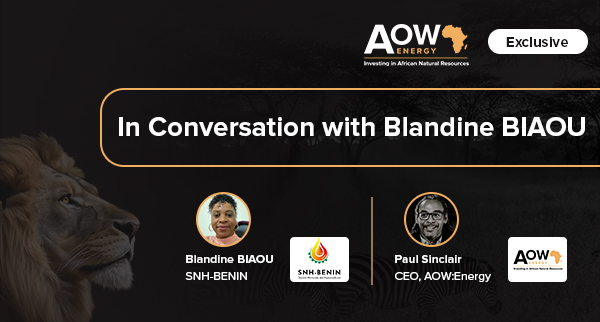
In Conversation with Blandine Biaou Oyede
Share:
Data, Discovery and Defining the Future of Benin’s Upstream
An Interview with Blandine Biaou Oyede, Director of Exploration & Data Management at SNH-BENIN SA, and Paul Sinclair, AOW:Energy
“Well-structured data is the foundation of modern exploration, and the gateway to investment.”
Paul Sinclair: Blandine, it’s a pleasure to have you with us. With over 15 years of experience shaping Benin’s upstream sector, its no surprise that you were nominated for the AOW:Energy Explorationist aware, I have to say very deserved.
I also have to say, it was a real pleasure visiting Cotonou and spending time with you and the team, and getting to know the city. Benin is really a hidden gem, and I really enjoyed getting a much deeper appreciation of both the country, and your ambition driving the sector forward.
How does it feel to see that momentum building and the industry beginning to take notice?
Blandine Biaou Oyede: Thank you, Paul and it was amazing to have you in Benin. Yes, it’s very encouraging to see how both West African and Benin is progressing, and also very humbling to be a part of this exciting period. For me, this recognition is really something special not just for me, but I hope it reflects what we are achieving, and seeking to achieve in Benin. I just hope that the work we have been working on is reflected further in the success for Benin, we really believe the upstream potential here in something special and a continuation of the amazing subsurface across the Transform Margin.
Over the past few years, we have taken a very deliberate approach to how we develop insights into our upstream and how we market it. We understand that to attract serious investment, we needed to strengthen the fundamentals both above and below ground, and this starts with data, governance, and technical credibility. That has meant reorganising our datasets, reassessing our petroleum systems, and creating a much clearer and more coherent understanding of our basins.
At the same time, we are focused on building a sector that is transparent, structured, and aligned with international standards. Investors today are looking for predictability, clarity, and confidence and that’s exactly what we are working to deliver in Benin. Whilst you might expect me to say this, I really believe Benin has amazing above ground frameworks which match the subsurface of proven petroleum systems that offer commercial opportunities for the country and investors.
What is particularly rewarding is seeing how these efforts are beginning in the industry. There is a growing awareness that Benin is not just a highly prospective upstream market, but we offer a highly competitive business environment.
For us, this is just the beginning. The momentum we are seeing now gives us confidence that we are on the right path and one that will ultimately lead to new partnerships, new data, and, hopefully, new discoveries.
Paul: Let’s start with your work. You’ve led some critical projects across your career and seeing you at the ECOWAS event certainly underlined your deep understanding of the Benin upstream, but what stands out as the most impactful project you have worked on.
Blandine: The project I’m most proud of is the national petroleum data collection and reorganisation programme.
It may sound simple, but in reality, but it really is transformative in terms of what we can show investors and the manner in which it is set out. We have developed a well-organised, high-quality data set that is serving as the foundation of modern exploration in Benin. In my view Paul, without it investment decisions are harder, sometime even delayed or avoided. So now we have a system that is more investor and private sector friendly and this allows us to engage much easier with the global upstream sector.
By restructuring and consolidating our datasets, we’ve created a more reliable, accessible, and scientifically rigorous foundation for exploration. That directly improves how investors assess opportunities in Benin.
Alongside that, I led a comprehensive review of the petroleum systems in the Benin sedimentary coastal basin. This was about stepping back and understanding the basin in an integrated way that gives more insight across broader acreage. We can interpret larges sets of data, the source rocks, migration pathways, traps, and overall dynamics which we are seeing huge upside from, the feedback from the private sector has been hugely encouraging.
That work provides a clear geological narrative, which is essential for both national strategy and investor confidence.
Paul: That focus on data and systems thinking is something we’re seeing more across Africa. How is that translating into current activity in Benin?
Blandine: We are now entering a very exciting phase as a sector and for our country. Our priority is to stimulate partnerships with operators to generate new data and enhance existing datasets. This includes new seismic acquisition programmes and the planning of exploration and production drilling campaigns.
The objective is clear from our leadership is clear, reduce uncertainty, improve subsurface understanding, and accelerate exploration activity.
Paul: Where specifically are you seeing the greatest opportunity?
Blandine: The Dahomey Embayment the Avon Fan, is particularly promising.
The Avon Fan is especially interesting, it is shared between Benin and Nigeria deep water and represents the deep-offshore continuation of the Niger Delta system. This makes it a highly prospective deepwater environment, with strong geological parallels to proven hydrocarbon provinces.
When you combine that with its connection to the broader Dahomey system, you begin to see a large, continuous petroleum system extending across borders.
Paul: And how do recent global discoveries influence your outlook?
Blandine: They are extremely important because they provide validated analogues. Discoveries like Baleine and Calao in Côte d’Ivoire, as well as Liza in Guyana’s Stabroek Block and Calamar and Ahanga in Brazil, show us what is possible when similar geological systems are fully understood and explored.
These basins are part of the same Atlantic margin story, they share common origins prior to continental separation.
So when we see success on one side of the Atlantic, it reinforces the potential on the other. It gives us confidence that similar plays may exist within Benin’s offshore basins.
Paul: That cross-border perspective is critical. What role does collaboration play in unlocking that potential?
Blandine: It’s absolutely essential. Exploration today cannot happen in isolation, the world in general is a part of an intertwined village which is interdependent for success. We need to strengthen collaboration between governments, national oil companies, international operators, financial institutions, and technical partners for success.
At the same time, there is a growing need for cooperation between countries that share the same basins. By aligning strategies, sharing data where possible, and creating consistent frameworks, we can significantly accelerate exploration success across the region.
Paul: And platforms like AOW:Energy, how do they support that?
Blandine: They are very important indeed, AOW : Energy is a longstanding flagship for the African Upstream and every year we see new deals happen at AOW, and we see new interest and market entrants in many countries as a result of the AOW : Energy conference, so we think to always be there.
AOW : Energy creates a framework for connection and dialogue. It brings together all stakeholders and gives them the opportunity to engage, align expectations, and explore new opportunities.
It also allows countries like Benin to present a clear and refreshed vision to the global market something that is essential when you are building momentum. It allows us to showcase new datasets, reprocessed insights and open acreage.
Paul: Looking ahead, how do you see the future of exploration in Africa?
Blandine: Africa remains a continent with immense geological potential, much of which is still underexplored. We are seeing a new influx of energy and commitment across the region. From new entrants in Guinea Bissau, great success stories in Cote d’Ivoire and excitement building on the transform margin, I really believe its now Africa’s time. West Africa is particularly exciting as the markets are seeing a new wave of operators committing. Then you have the ongoing work in Angola, Namibia, Mozambique and you realise Africa is now. And I didn’t even mention Benin!
The future will depend on our ability to balance hydrocarbon development with collaboration, innovation, and the development of local talent. I believe strongly in an exploration model driven by better data, shared projects across borders and a clear and consistent regulatory frameworks
I really believe for regions like the Gulf of Guinea, the future is very promising.
Paul: And finally, what message would you share with the next generation of geoscientists?
Blandine: I would encourage them to be curious, independent, and rigorous. Always question the data, strive for excellence, and continue learning.
Africa is a place where innovation can truly transform our understanding of the subsurface, and where the next generation has the opportunity to shape the future of energy.
Paul: Blandine, thank you. This has been a fascinating insight into both your work and the future of Benin’s upstream sector. We look forward to welcoming you at AOW:Energy 2026 and celebrating your story, success and Benin as a whole, you
Through leaders like Blandine Biaou Oyede, we see a new chapter emerging, one defined by data-driven exploration, regional collaboration, and renewed investor confidence.
Join Benin in Accra, Ghana (1–3 September 2026) to connect with the people and opportunities shaping Africa’s upstream future.