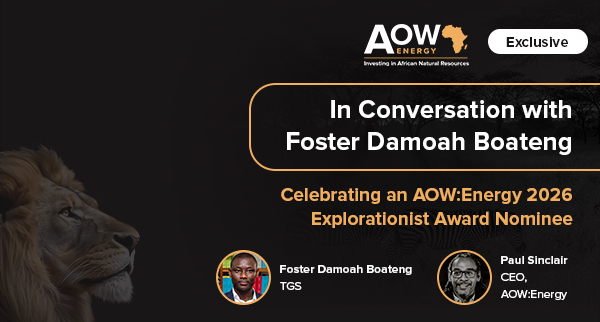
In Conversation with Foster Damoah Boateng
Share:
Celebrating an AOW:Energy 2026 Explorationist Award Nominee
An Interview with Foster Damoah Boateng, Project Geoscientist at TGS, and Paul Sinclair, AOW:Energy
“Exploration is about seeing the bigger picture and having the courage to follow it.”
Paul Sinclair: Foster, first of all great to see you again and congratulations. Being nominated by the industry for the AOW:Energy 2026 Explorationist Award is no small achievement. How does it feel to receive this recognition?
Foster Damoah Boateng: Thank you, Paul. It’s a real honour especially knowing the nomination comes from peers across the industry. Exploration is never an individual effort; it’s built on collaboration, shared data, and collective insight. So for me, this recognition reflects not just my work, but the broader teams work at TGS and of course that of our government partners and private sector partnerships that have contributed to advancing our understanding of the region.
Paul: So Foster, your work across the West Africa Transform Margin has been widely recognised both amongst the G&G community and in particularly through government partners that use the TGS MegaSurvey projects. What makes this work so impactful?
Foster: The MegaSurvey concept has fundamentally changed how we approach exploration. Traditionally, the industry has worked within block or sub-basin perspectives, but what MegaSurvey does is allow us to step back and understand the entire petroleum system at a true basin scale.
At TGS, these MegaSurveys are built by merging vast volumes of 2D and 3D seismic data into a single, seamless regional dataset, creating a uniform, phase-balanced view of the subsurface across entire margins. This allows us to visualise play systems, migration pathways, and structural frameworks in a way that simply isn’t possible when working in isolation.
What’s powerful is that this approach has already been proven globally from the North Sea, where the concept was first developed, to major basins across Africa, South America, and beyond, covering hundreds of thousands of square kilometres.
In West Africa, particularly along the Transform Margin, this regional perspective has been transformative. It allows explorers to Screen entire basins quickly and consistently, Identify geological analogues across borders, Build confidence in play fairway analysis and prospectivity, and ultimately de-risk exploration decisions before capital is deployed
We’ve seen how this kind of integrated dataset can directly support licensing rounds, new market entry, and renewed exploration interest, because it gives both governments and operators a clear, coherent geological narrative to work from.
In regions like Côte d’Ivoire, Ghana, and across the wider Transform Margin, this “big picture” approach has helped connect discoveries, improve appraisal outcomes, and highlight consistent geological themes across basins.
For me, that’s what makes MegaSurvey so impactful as it represents a framework for thinking differently about exploration. It enables us to move beyond isolated opportunities and start understanding how entire margins work as systems, which is where the next wave of discoveries will come from.
Paul: That regional view seems to be unlocking new momentum across Africa. What are you seeing today in terms of exploration trends?
Foster: There’s definitely a renewed focus on deepwater exploration, and importantly, we’re now seeing the results of that through a series of significant discoveries across the margin. But what’s really driving this momentum is a shift in how geoscientists are screening and interpreting data at a regional scale.
When we work with multiclient datasets today, it’s no longer about evaluating a single block or prospect in isolation. The real value comes from building a big-picture understanding of entire margins, integrating datasets across basins, across countries, and even across continents.
What that enables is a much more powerful approach to exploration. Instead of asking “what does this block look like?”, we’re asking bigger questions such as “How do discoveries in one basin translate into opportunity in another?”
This is where analogue thinking and conjugate margin analysis become incredibly important.
If you look at the South Atlantic margins, for example, there are well-established geological parallels between West Africa and Brazil. By understanding how systems evolved prior to continental separation, we can identify mirrored play types, similar source rocks, and comparable structural settings.
This is especially important for investors and operators entering new markets. The ability to quickly understand where risk has already been reduced elsewhere, and how that translates geographically is a major advantage.
What we’re seeing now is the industry moving toward a much more holistic, system-based approach to exploration, where data, analogues, and regional context all come together.
Paul: Let’s talk about the future. Where do you see the next major opportunities?
Foster: One area I’m particularly excited about is the Keta Basin, along the Transform Margin. At TGS, we’re preparing a 3D multiclient acquisition programme in both the Keta and Benin Basins, specifically aimed at closing critical data gaps and unlocking a clearer understanding of deepwater prospectivity.
The Keta Basin is especially interesting because, while it remains relatively underexplored compared to its western counterparts, it sits within a proven petroleum system that extends across the margin.
That’s exactly what this next phase of 3D acquisition is designed to address. By improving imaging, particularly in deeper water and structurally complex areas, we can start to de-risk plays, identify new prospects, and build confidence for exploration investment.
When you overlay this with what we’re seeing in the Keta and Benin Basins, the parallels become very clear. The seismic characteristics, structural styles, and stratigraphic sequences suggest that similar play types extend across the Dahomey Embayment.
In essence, we’re looking at a margin where proven success in one area can be translated into opportunity in another—provided we have the data and regional understanding to make those connections.
The conclusion is that there is still significant untapped potential across this part of West Africa. And with improved imaging, integrated datasets, and a regional approach to interpretation, we are now in a position to systematically unlock it.
Paul: It’s fascinating how data continues to reshape the narrative. What role does technology and data play in modern exploration?
Foster: It’s everything. The ability to access vast multiclient 2D and 3D datasets across borders allows geoscientists to assess geological analogues with a level of confidence and precision we’ve never had before.
Exploration used to be much more fragmented. Now, with integrated datasets, we can build coherent geological models across entire margins, not just individual blocks. That’s a game changer.
Paul: You’ve been part of the industry for seven years what are you most proud of in that journey so far?
Foster: I’m proud to have contributed to a body of work that is helping unlock Africa’s upstream potential in a meaningful way.
Exploration is about reducing uncertainty, and if our work helps companies make better decisions, de-risk investments, and ultimately lead to discoveries that’s incredibly rewarding.
But beyond that, I’m proud of being part of a generation of geoscientists who are collaborating more openly and thinking regionally to upack new insights and develop more incentive for new market entry amongst the regional and international operator community.
Paul: That spirit of collaboration is something we see strongly at AOW:Energy. What does the platform mean to you?
Foster: AOW:Energy plays a critical role. It brings together exploration companies, governments, and financial institutions in one place, which is incredibly powerful. Not only that, but for me AOW:Energy coming to my home country is massive for the exposure it give Ghana and the West Africa region. The move to Ghana was timely, we are seeing huge excitement across West Africa and I truly believe this event will add huge impetus to the speed in which we see new companies enter the West African market.
These are conversations that might take months to coordinate, but at AOW, they happen in days. Countries can showcase opportunities, companies can understand regulatory frameworks, we showcase data rooms, we know the international new ventures and exploration community attends as they did so on mass in 2025, and partnerships can form much more quickly.
It really accelerates the pace of the industry.
Paul: And in terms of the broader industry, what message would you share with your peers?
Foster: No single organisation can unlock a basin alone. Real progress happens when we share knowledge, challenge each other, and build long-term relationships. The discoveries we’re seeing across Africa today are the result of technical insight, policy alignment, and investment coming together with purpose.
That’s the future for me and platforms like AOW:Energy are essential to making that happen as they convene the who is who of the market in one place. What we are seeing with AOW:Energy is a true niche, the broader energy conversation dominates, but at AOW:Energy the return to the upstream really gives purpose and concentration of the right people looking at upstream opportunities
Paul: Finally, Foster this nomination celebrates not just your work as an individual, but it is a true recognition of your impact on the industry. What does the future hold for you?
Foster: For me, it’s about continuing to push boundaries, committing to being the best and finding solutions for both TGS and our partners. I am really very proud of the work we do, the manner in which we do it and our commitment to the industry
Africa’s subsurface story is so exciting, honestly, I really believe there is is so much more to come, so many more success stories and so much excitement on the horizon. Its all there to be seen and the next big story I believe is still being written, and I’m excited to be part of a community that is helping to unlock its full potential responsibly and sustainably.
Paul: Foster, it’s been a pleasure. Congratulations again on your nomination, im personally really pleased to have seen your name on the nomination list and congratulation, you are making waves in the upstream and long may it continue, we look forward to celebrating you at AOW:Energy 2026.