In Conversation with Aida Souaré
Share:
Guinea`s position on the Global Exploration Map
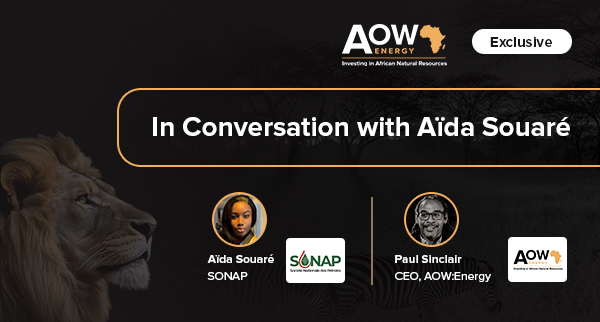
An Interview with Aida Souaré, Promotion Manager at SONAP, and Paul Sinclair, AOW:Energy
“Countries may have borders, but geology doesn’t and Guinea is fast-tracking to an exciting new era of upstream development.”
Paul Sinclair: Aida, it’s a pleasure to speak with you. Guinea is increasingly being discussed as a high potential emerging opportunity in the West Africa upstream context, and much of that visibility is down to the work you and your team have been doing and SONAP. How does it feel to be getting so much interest in the Republic of Guinea through the work of SONAP Guinea and what is next for Guinea in terms of the global exploration landscape?
Aida Souaré: Thank you, Paul. It’s both exciting and I really hope this opportunity also allows me to set out more information about the Guinea oil and gas sector to attract more interest, but for now I am just happy to be speaking with you to discuss what the future holds and the overall situation in Guinea today. We have been working hard to bring clarity to our sector, to the opportunity in Guinea and the full potential of our geology. The world is very competitive with so many places developing innovative frameworks for competitiveness, and we understand this and we are also looking at ways to attract more investment.
One of my key objectives has been to stimulate the interest in our subsurface and to ensure Guinea is talked about in the same way as our neighbours who have had a lot of success in terms of new entrants.
Over the past few years, we’ve worked to enhance the visibility of Guinea’s exploration potential, not just at an institutional level, but also within communities and among international stakeholders to set out the collaborative and sustainable approach we are taking to exploit our basins
It’s rewarding to see that this effort is beginning to translate into real engagement, with several oil companies now showing interest and even submitting contract applications. That, for us, is a strong sign that the message is being heard.
Paul: Repositioning a country takes time and strategy. What have been the key pillars of your approach?
Aida: The foundation has been consistent promotion backed by credible technical messaging.
At SONAP, we are promoting Guinea’s hydrocarbon potential, however we are also actively working with partners to enhance the attractiveness of our sedimentary basin.
This includes improving data availability, strengthening our technical understanding, and ensuring that when investors look at Guinea, they see a structured and forward-looking opportunity.
The other positive outlook for Guinea is the prolific MSGBC basin that we sit within. When you look at what has been ahchieved in Mauritania and Senegal you begin to realise that the same opportunity lies in Guinea via the same petroleum systems and basin profile.
Guinea is very well positioned within the broader MSGBC Basin, which is increasingly recognised as one of the most prolific and geologically compelling frontier regions globally.
From a subsurface perspective, this margin tells a very coherent story. The MSGBC basin is characterised by proven Cretaceous petroleum systems, high-quality source rocks, and well-developed deepwater turbidite reservoirs, which have already delivered major discoveries across Mauritania and Senegal.
What makes this region particularly powerful is the scale and continuity of its geological framework. The basin extends across multiple countries, from Mauritania down to Guinea, yet remains connected through shared play systems.
Through large-scale regional seismic datasets and integrated studies, we can now see how these play fairways extend across borders, linking discoveries and highlighting new areas of opportunity. This “big picture” view is essential, it allows us to move beyond isolated prospects and instead understand the entire petroleum system as a continuous, working system.
For Guinea, this is very significant. It means we are not starting from zero, we are part of a proven, regionally validated petroleum province, where recent discoveries and ongoing exploration success are helping to de-risk adjacent areas.
When you combine this with the conjugate margin relationship to Guyana-Suriname, where similar source rock intervals and depositional environments have delivered world-class discoveries, the subsurface case becomes even stronger.
All of this contributes to a compelling exploration narrative for Guinea, one that is grounded in regional success, supported by modern data, and increasingly understood through integrated basin-scale analysis.
Paul: I agree Aida, we did an interview with TGS recently and they were saying the same thing, the big picture is playing a more important role when screening data; so I think Guinea is on the cusp of some exciting times. But what can the industry expect next from Guinea in terms of exploration activity?
Aida: We are entering an important phase. SONAP is planning to launch FTG (field technical and geological) activities in the near future across our onshore acreage, alongside the acquisition of additional data to strengthen our understanding of the subsurface.
At this stage, no drilling programme has been finalised, as we are still in discussions with potential partners. However, the objective is clear: to build a solid technical foundation that will support future exploration and investment decisions.
Paul: From a geological perspective, how do you position Guinea within the broader West African story?
Aida: Guinea is very well positioned. When you consider our geographical location, the results from previously drilled wells, analysed samples, and the identified prospects, there is strong evidence supporting the prospectivity of our sedimentary basin.
As I said before, the MSGBC Basin is increasingly recognised as a geological analogue to Guyana.
That comparison is significant because it highlights the potential for major discoveries in underexplored basins, driven by similar geological histories and petroleum systems.
Paul: We’ve seen major discoveries in the region in recent years. How do these influence your outlook?
Aida: They are extremely important. Discoveries in Senegal and Côte d’Ivoire, for example, are highly relevant to Guinea because we share similar geological structures and basin characteristics.
What works in one basin can often be translated into opportunity in another, and that gives us strong confidence in Guinea’s potential.
Paul: Are there specific prospects or areas that stand out?
Aida: Yes, there are several promising prospects, particularly within Blocks A4 and A5, as well as those previously identified by operators such as Hyperdynamic.
While earlier drilling, such as the Sabu and Fatala wells resulted in non-commercial discoveries, they still provided valuable data and insights regarding the broader upstream potential of Guinea
In exploration, every well contributes to the understanding of the basin, and these learnings are helping us refine our models and identify more targeted opportunities going forward. What we would encourage is more operators contacting SONAP to get a deeper understanding of what we know from the activities that we have undertaken across the years.
We know far more now than we ever did as an institution, and we want to continue to tell that story.
Paul: Let’s talk about collaboration and platforms like AOW:Energy. What role do they play for countries like Guinea?
Aida: AOW:Energy is an essential platform for SONAP. With more than 30 years of experience promoting Africa’s energy potential, it brings together governments, national oil companies, international operators, investors, and service providers in one place.
Over the years of attending AOW:Energy I have learnt that it’s a special platform that is unique and that creates a unique environment where connections are made quickly and opportunities are clearly presented
For a country like Guinea, this is invaluable. It allows us to engage directly with decision-makers and position our opportunities on a global stage.
Paul: And finally, what is your message to the industry?
Aida: Africa remains one of the most promising regions for exploration globally, and Guinea is a key part of that story.
We encourage companies to look closely at our basin, to engage with us, and to be part of the journey as we continue to unlock our potential.
At the same time, I believe all African countries can benefit from stronger collaboration through platforms like AOW:Energy, because ultimately, it is through partnership that we will achieve long-term success.
Paul: Aida, thank you. It’s inspiring to see the work being done to reposition Guinea, and we look forward to welcoming you to AOW:Energy 2026.
AOW:Energy 2026 – Unlocking Africa’s Next Exploration Frontiers
Through leaders like Aida Souaré, new opportunities are emerging, driven by visibility, collaboration, and a renewed belief in Africa’s geological potential.
Join us in Accra, Ghana (1–3 September 2026) and be part of the conversations shaping the future of exploration across the continent.